Today, the owners of AirBnB, Über and similar web based platforms, are minting money on the supposed pillars of a ‘sharing economy’. Like much of what emanates from Wall Street, it is anything but ‘sharing’. It is web-based raw blooded capitalism. Pure and simple.
For examples of what really constitutes a sharing economy, region or sector, one must look elsewhere. For example, in the Basque Country where Mondragon is hailed as the planet’s largest cooperative. Perhaps more corporation than cooperative today, it nevertheless stems from a rich tradition of Basque sharing which has been around for centuries.
Given that Catalonia (Catalunya) is more in the news in its battle to declare itself a Republic, is there anything of this in their history?
The short answer is yes.
Especially when we widen the definition of sharing to that of sharing of power and resources.
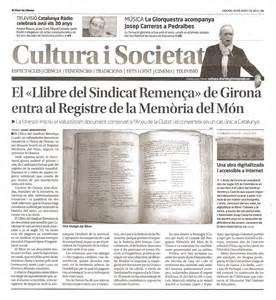
In 1448 a remarkable book was published in Girona, a town in Catalonia. The book, entitled “Llibre del Syndicate Remença” or Book of the peasant ‘syndicate’, is a diary of meetings held by peasants where the discussion revolved around abuses committed by the lords.
They wanted decent living conditions and elected representatives (syndics) to negotiate with the powers that be. The serfs would refrain from rebelling on condition of good behaviour by feudal lords. Twenty years later, the king of Aragon abolished dome of the worst rights of the lords.
Four centuries later, in 1843, Barcelona saw its first true cooperative when 200 textile workers banded together. Incidentally, given that the industrial proletariat emerged first in Catalonia, the first trade union in Spain was established there too. (followed swiftly by the Basques).
The backdrop was the rampant industrialisation in both regions north of the Ebro. The Spanish state was absent. Workers and the general population had to fend for themselves in this rapidly changing society. Even farmers formed some of the first cooperatives in the late XIX century.
In the XXI century, after the collapse of the housing bubble, banks and authorities started evicting people from their homes. A new collective of volunteers sprang up, the Platform d’Afectats per la Hipóteca (PAH). The current of Mayor of Barcelona, Ada Colau, rose to prominence through this campaign.
Farid Erkizia Bakht
 iecosoc.net
Leave a comment